Hello! I’m Clarity, and I’m the original Mama Palooza! I am a PDA adult, raising PDA kids, and the author of a children’s book with neurodivergent representation… including PDA. So, like my character Ellie, I say stuff how I see stuff. Also like Ellie, I have a lot to say!
So, I thought I'd give this a try. Throughout this blog, we’ll dig into the PDA world, and how we can best navigate it. With a background in psychology, decades of lived experience, and my special interest in PDA, I do have some tricks up my sleeves! We’ll talk about the importance of steps like lowering demands, accommodating the nervous system, radical acceptance, declarative language, and authenticity vs. masking.
And throughout it all, we’ll look at how Mama Palooza… the wonderfully weird, goofy, rule-bending grownup in our children’s book series… puts all of this into practice.
Neurodivergence is a Spectrum
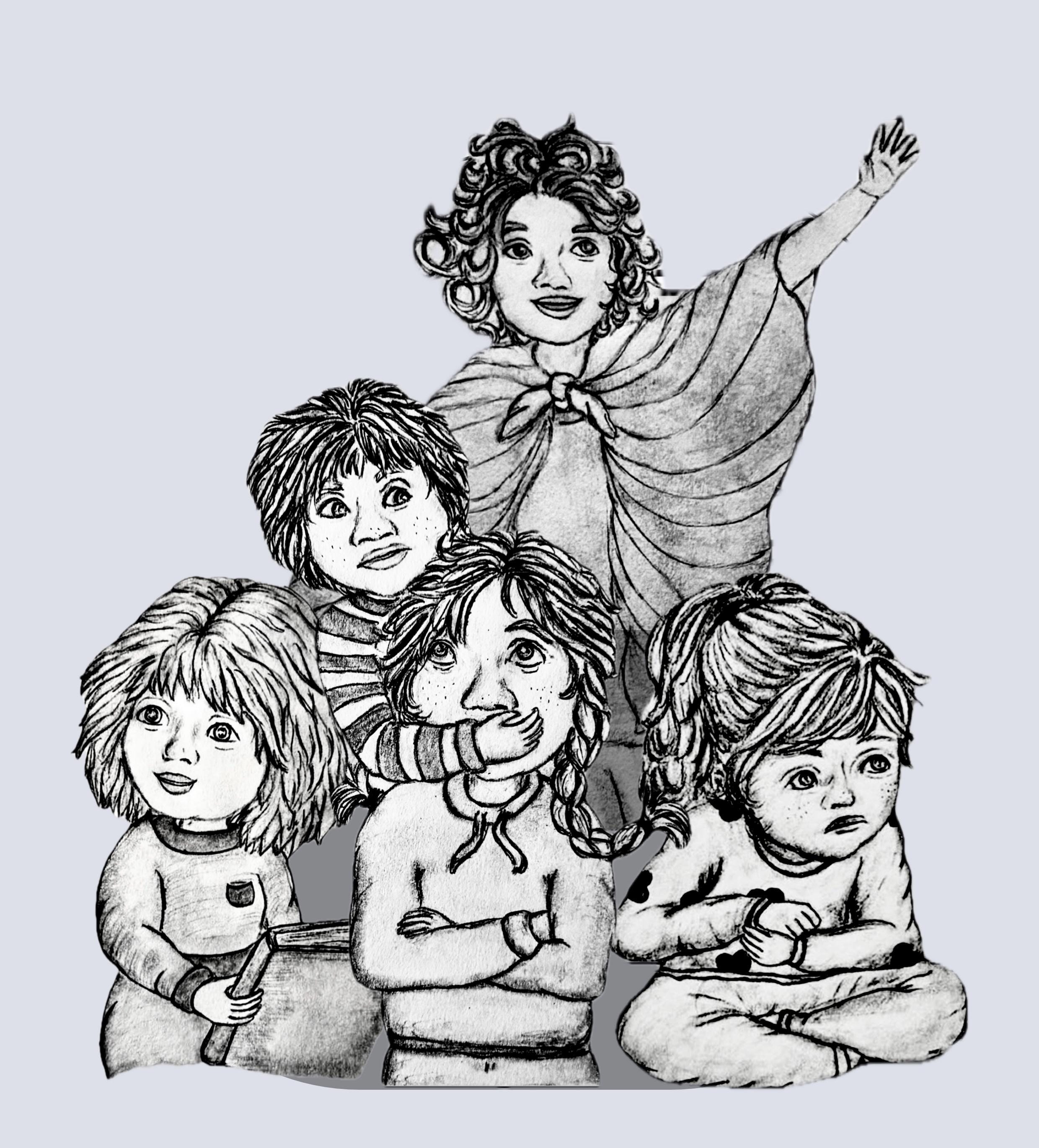
But, let me back up a little bit here. In the Mama Palooza stories, we can see all variations of neurodivergence. From ADHD (Attention Deficit Hyperactivity Disorder), to ASD (Autism Spectrum Disorder), and then a particular profile of autism — PDA (Persistent Drive for Autonomy). So, let me introduce you to four kids who are going to do a lot of the explaining for me.
Meet Bella, Grace, Ellie, and Jack!
Each of them experiences the world differently. And for this discussion, each of them is going to help us understand something really important about neurodivergent brains. Neurodivergence is a spectrum, and shows up differently for everyone. Keep in mind, these descriptions each represent one profile. In real life, neurodivergent kids carry pieces of several of these experiences at once.
Bella, Autism Spectrum Disorder
Bella is on the autism spectrum, and finds her peace in routine, order, and often, her special interest. In the story, when things became too sensory overstimulating, Bella retreats to her “book nook” to organize her books by author. This example shows that she needed to escape from the sensory chaos, and engage in organizing in her own established ways. Finding her quiet space, using her routines, and involving her special interest (books) allowed her to engage in her own way, parallel to her siblings.
Grace, ADHD
Grace’s mind moves faster than the world around her.
It was ADHD that made Gracie appear “bossy” in the Palooza stories, when trying to tell the other kids how to get started. Her mind is running faster than others, her thoughts are coming in quick, and she is simply frustrated and trying to move people in a direction she can already see would work.
"Bella, just stack your books. Ellie, I know these are your crayons. Jack, these are your stuffies. You pick those up."
Her goal is not to be "bossy." With ADHD, she can sometimes see the whole story before it has played out, and just wants to get a move on.
Ellie & Jack, PDA Profiles
Our remaining characters, Ellie and Jack, represent the PDA profile. This means they have neurodivergence… with a kick. Ellie, as an internalized PDAer, battles a war entirely inside herself. Any threat to her autonomy can send her right into a freeze response.
And Jack…well, Jack shows us how externalized PDA can result in his Harriet the Hedgehog stuffy ending up kicked across the room. The fight response is real, and can take over before he even knows it. You’ll be hearing a lot about these four! For today, let's dig a bit deeper into Ellie and Jack.
First of All, What Is PDA?
Persistent Drive for Autonomy (PDA), also known as Pathological Demand Avoidance, is a profile of autism that describes a very strong threat response in the nervous system. Really, PDA shows up as feeling like a nervous system disorder that causes big challenges in things like regulating emotions, impulse control, and even daily functioning.
This Is Not a Behavior Problem
The nervous system is a big deal, and PDAers need support with a wide range of things, including eating, sleeping, hygiene, meltdowns, and so much more. This looks to the world like a behavioral choice, a kid that chooses to act out.
But that's not even close to the truth. They are stuck and along for the ride, feeling every bit as out of control as the adult trying to help. This is a biological response, and we have the science to show us why.
A Biological Response
The problem for a PDAer happens when the brain perceives demand of some kind. A PDA brain views any type of demand as a threat to autonomy, and a need to immediately activate survival mode. A shift in tone, an unexpected question, or a simple request will hit the PDA brain like a declaration of battle.
It’s not always so much the demand to do something, either. Nope, it is far more nuanced than that. It's also the demand felt by the brain when an unforeseen circumstance, or unexpected request, requires the mind to change focus. This brings a sense of lost control, throwing the PDAer right into survival mode.
The Brain Reacts
Survival mode is tricky. It’s meant to protect us, but in this case… oof, does it cause some challenges. Typically in the brain, when a request or demand is perceived, the prefrontal cortex (the thinking center of the brain) will interpret these things, figure out what they are, and decide on a response.
But, for the PDAer, there’s a problem: a hyperactive amygdala. This is the part of the brain in charge of emotional processing and threat detection. So, when it perceives that a demand of any kind is heading toward the prefrontal cortex… well, it gets spicy.
Nope! Not on my watch! Nervous system, activate!
The amygdala takes over, and no thoughts get through. Fight/flight/freeze only… the fear is real and intense. In other words, a hyperactive threat response, met with an inability to think that danger through, means the child is no longer in the driver’s seat. The biological response has taken the wheel.
This is known as nervous system activation, and it can wreak havoc on an unsuspecting kid who’s simply been asked to brush their teeth.
Internalized PDA: Meet Ellie
An example of this threat response can be seen with Ellie’s inner monologue. Ellie has an internalized PDA profile. When her nervous system is overwhelmed, she’s stuck in a “freeze” state. While autism freeze can stem from many things, including sensory or processing overload, Ellie's freeze comes from the demand itself. She knows what to do, she knows she's capable of the task… she just can't make it happen.
Ok, let’s go, self. Stand up! Grab a book. Put it on the shelf. That’s so easy. You can do it. Okay, one… two… three—GO! But—nope. My pep talk did nothing. Nice try, self, but I am still stuck!
No matter how she tries, her mind just keeps spinning, unable to move forward. This is because with an internalized PDA profile, her nervous system has gone into a freeze state in response to a demand.
Which book? Which shelf? Is the shelf clean, or will I need to do that first? I am the oldest. Should I help the little kids first? Are they even gonna help? Why can't I just start this chore?
Externalized PDA: Meet Jack
Unlike Ellie, Jack has an externalized PDA profile. Meaning, he will have more of an outward response to any loss of autonomy. Yes, you guessed it… this is why in the story, poor Henrietta the Hedgehog ended up kicked through the playroom. Jack felt threatened by the demands he was facing, and lashed out at poor Henrietta.
This type of response, known as equalizing, is a way for the brain to feel an equal level of control or power over the situation. So, if he's told he “must” complete a chore, or Jellybean runs through and destroys the pillows he was stacking, his brain reacts. It sees a threat to his choices and his control over his environment, and pushes his nervous system into a fight response.
After all, like Ellie says in the story, everyone knows Jack's brain is allergic to taking orders.
This Is Not the Teaching Moment
In each example, the end result is the same. The nervous system is dysregulated, and sends the child into survival mode. This is a biological response, and can feel scary, unsettling, and very out of their control. And, of course, survival mode has no time for reasoning.
During this time, the brain is sending all of its focus toward threat and safety, and conversations can’t be processed. Not won’t… can’t. Think about what that means.
Any request to stop and think, or just do what I asked, or go sit for a minute… that’s just activating the brain further. The PDAer is dysregulated, and cannot think. That is essentially asking a child to override a nervous system response to a hyperactive amygdala. That’s just… not a thing.
Can you do that? I know I can't. And believe me, as a PDA adult, I've been trying for a long time. But, no, I need support with regulating my nervous system.
The only way to help the PDAer regain the wheel is to provide co-regulation support, in order to accommodate the nervous system that has taken control.
Accommodations & Co-Regulation
Since I did have so much to say today, I will save the in-depth talks about co-regulation for the next post. In short, for a PDAer, co-regulation support means whatever can be done to instill a feeling of safety, validation, and autonomy.
Anything that shows them: I hear you. I see you. I know you, and I’m on your side. I'm not in charge of you. You are in control. You are safe here and you are valued here. I will calmly help regulate your nervous system so you can focus on being yourself.
The reality is, there is no sticker chart, set of rules, or time-out system that can regulate a child with an activated nervous system. Typical parenting strategies just aren’t effective here.
In fact, the best advice I can give on PDA parenting? Be a weirdo. A quiet goofball. A shocking silly adult. For a PDAer, a little different can be a game changer.
For the next post, we’ll step into Mama Palooza’s world and watch these concepts come to life. In book one, she turns a doomy, dysregulating chore into a fun, kid-led adventure. We’ll go through just how she uses novelty, humor, and declarative language to meet Ellie, Jack, and the rest of the crew right where they are… nervous system and all.
Until then, remember: you know your child above anyone else. Trust that. 💛